CANCELED: The Diesel Policy Dilemma
September 30, 2026 • 11:00 am – 12:00 pm EDT

Photo: AFP/Getty Images
Russia has lost the military initiative in Ukraine as costs continue to mount. The Russian military has suffered 1.4 million battlefield casualties and as many as 450,000 deaths since its February 2022 full-scale invasion, according to new CSIS data. Russia’s territorial control in Ukraine shrank in the spring of 2026, with a net loss of roughly 400 square kilometers in April and May. In addition, Ukraine has orchestrated an increasingly successful campaign of short-, medium-, and long-range strikes against Russian military and economic targets using AI-enabled systems and a new paradigm for air power.
In a stunning acknowledgement of Russia’s struggles in Ukraine, President Vladimir Putin dramatically scaled back his annual military parade in May 2026 because of concerns about Ukrainian long-range strikes and increasing battlefield challenges in Ukraine. For many Russians, 2026 has been a difficult year. Everyday Russians are suffering from a sputtering economy, higher prices on groceries and other expenses, tax increases, significant internet restrictions, and an oppressive crackdown on freedom of speech—largely because of the war in Ukraine. In addition, major cities throughout Russia, such as Moscow and St. Petersburg, have come under attack by Ukrainian drones and long-range missiles, not just towns and cities in Russia’s border region with Ukraine, such as Belgorod, Bryansk, and Kursk. Crimea has also come under withering attack by Ukraine, forcing Russia to close summer camps and beaches, disrupting fuel supplies, and causing electricity outages.
But much of the analysis on Russia’s battlefield performance has been anecdotal. This study examines several indicators of Russia’s battlefield performance compiled by CSIS: fatality and casualty rates, rates of advance of Russian forces as measured in meters per day, and Russian territorial gains in total square kilometers. It also collects and analyzes data on over 20,000 incidents involving Ukrainian strikes against Russian targets. What does this data suggest about Russia’s military performance in Ukraine?
First, Russian battlefield costs continue to mount, with as many as 450,000 battlefield deaths and 1.4 million casualties between February 2022 and June 2026. These rates are astounding. Russian fatalities in Ukraine are more than four times greater than all U.S. fatalities in all wars combined since World War II, and more than nine times greater than all Soviet and Russian fatalities in all wars combined since World War II.
In addition, Russia’s monthly casualty rates of over 30,000 per month in 2026 have likely exceeded Russia’s recruitment rates of roughly 27,000 new recruits per month. The Russia-Ukraine casualty rate has likely risen to nearly 8:1 in the first half of 2026, up from between 2:1 and 3:1 for much of the war, in large part due to Ukraine’s use of drones—including AI-enabled drones—as part of its aggressive air interdiction campaign.
Second, Russia’s ground offensive has largely stalled, with an average rate of advance of approximately 50 meters per day around Kostiantynivka, 70 meters per day around Pokrovsk, and 90 meters per day around Sloviansk. These are among the slowest rates of advance in any war over the last century.
Third, Russia’s territorial control in Ukraine shrank in the spring of 2026. Russian forces lost more ground than they captured in both April and May, a net loss of roughly 400 square kilometers and their first monthly net losses since August 2024—yet another sign of Russia’s military struggles.
The rest of this analysis is divided into five sections. The first outlines Russian war aims and the overall state of the war. The second section assesses Russian and Ukrainian casualties and fatalities. The third explores Russian rates of advance. The fourth section examines Russian territorial gains. And the fifth provides overall conclusions.
Putin’s primary objectives remain bringing Ukraine back into Russia’s sphere of influence and subjugating Ukraine, either directly by militarily conquering and annexing Ukraine (as Russia has done in Crimea and some areas of eastern and southern Ukraine) or indirectly by installing a Russian ally in Kyiv. Putin also likely seeks to destroy the credibility of NATO, prevent further NATO expansion eastward, undermine the European Union, and expand Russia’s sphere of influence in Eastern Europe.
Putin sees Ukraine as part of Russia’s historical empire under such czars as Peter the Great, Alexander III, and Catherine the Great, bound together by one language, economy, culture, and religion. As Putin argued in his essay “On the Historical Unity of Russians and Ukrainians,” Russians and Ukrainians are “one people—a single whole.” This myth of Russia and Ukraine as one is, of course, false. Ukraine has a distinct culture, a deeply rooted history, and a different language. The war has only strengthened Ukrainian identity and further distanced its people from Russia.
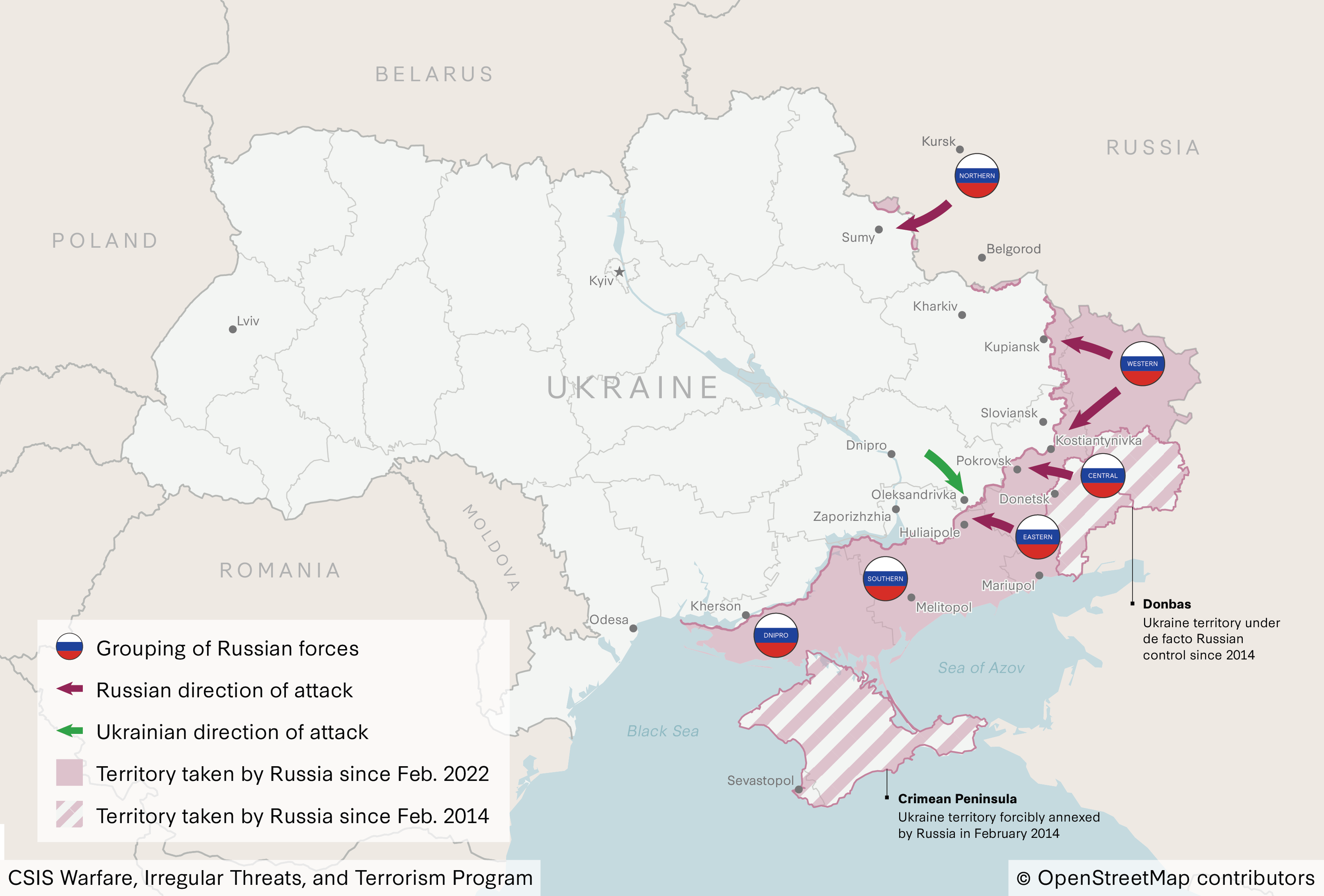
Source: UK Ministry of Defense; and CSIS estimates.
Russia’s military campaign has focused on several axes, as noted in Figure 1: northern Sumy Oblast, eastern Kharkiv Oblast, northwestern Donetsk Oblast, and northern portions of Zaporizhzhia and Kherson Oblasts. Russia has also aggressively targeted Ukrainian civilian and military targets with drones and ballistic, cruise, and occasionally hypersonic missiles. Russia has exploited a notable Ukrainian vulnerability: a limited supply of air defense interceptors, such as PAC-3 missiles. As Colonel Yurii Ihnat, a Ukrainian Air Force spokesman, noted using a sports reference, “A goalkeeper is standing in the goal, and suddenly 10 balls are flying at him at once. He cannot catch all of them. He can catch as many as he has hands and feet, right?” In addition, Russian forces continue to make improvements in such areas as electronic and drone warfare, creating operational and tactical challenges for Ukrainian forces. For example, Russia’s Rubikon Center for Advanced Unmanned Systems, a Russian military unit that specializes in drone warfare, has been effective at striking Ukrainian drone operators, destroying rear units, and severing supply lines.
As Figure 1 shows, Ukraine has also conducted offensive operations in 2026 in such areas as Oleksandrivka in Dnipropetrovsk Oblast. In addition, Ukraine has dramatically taken the war to Russian territory in 2026 by orchestrating a series of short-, medium-, and long-range strikes to disrupt and destroy Russian logistics and supplies. This is classic air interdiction, though with drones and missiles—not airplanes. According to CSIS analysis, Ukraine has struck several types of Russian targets:
As Figure 2 illustrates, Ukraine has conducted long-range strikes (greater than 300 kilometers from Ukrainian territory) against such cities as St. Petersburg and Moscow, as well as against such locations as Ukrainka Air Base—over 6,000 kilometers from Kyiv. Ukraine has also orchestrated medium-range strikes (30–300 kilometers) against targets in Kursk, Kaluga, Belgorod, and other oblasts. Finally, Ukrainian forces have carried out short-range strikes (less than 30 kilometers) against thousands of targets just across the border in Russia and in Russian-controlled areas of Ukraine, such as Crimea. These strikes have caused operational challenges for Russia, including decreasing Russia’s energy refining capacity, causing gasoline shortages in some areas, largely knocking out Russia’s navy from the war, disrupting logistics and supply lines, pummeling Russian-controlled Crimea, and attritting some industrial production. Nevertheless, the strikes have not crippled Russia’s war machine and have not fully destroyed—or denied—Russia’s military capacity to wage war.
In conducting its air interdiction campaign, Ukraine has used a combination of drones and missiles—including a major increase in AI that is changing the character of warfare. One recent development is the Ukrainian fielding of the Hornet, a one-way, autonomous attack drone that costs roughly $6,000 and has a range of up to 150 kilometers. It is part of a drone partnership between Ukrainian and U.S. companies. The Hornet uses AI to analyze live video feeds during the day and night; identify legitimate Russian targets with its target detection and algorithms; detect Russian decoys based on the platform’s geometry, surface texture, and thermal signature; and strike Russian targets using AI during the final phase of the flight with a built-in warhead. The Hornet and other types of AI-assisted drones decrease the threat from Russian electronic warfare systems by relying on onboard AI that does not need a satellite connection, which can be jammed. In addition, Ukraine has also used AI-assisted systems produced by such companies as SkyFall for counter-drone operations, including to help identify and destroy Russian first-person-view (FPV) drones.
According to CSIS estimates, Russian forces suffered approximately 1.4 million battlefield casualties—including killed, wounded, and missing soldiers—between February 2022 and June 2026, as highlighted in Figure 3. Russian forces suffered between 400,000 and 450,000 fatalities during this same period. These casualty numbers have increasingly become a problem for Russian recruitment. In 2026, Russia’s monthly casualty rates of between 30,000 and 34,000 casualties per month likely exceeded its recruitment rates of approximately 27,000 new recruits per month.
The number of Russian casualties and fatalities are astonishing. Since World War II, no major power has suffered anywhere near these numbers of casualties or fatalities in any war, leaving Russia with a grim and unparalleled recent historical record. Compared to the United States, for example, Russia has suffered roughly four times as many fatalities in Ukraine as the United States has in all its wars combined since World War II, as shown in Figure 4. The United States suffered 36,574 battle deaths during the Korean War, 58,220 deaths during the Vietnam War, 383 deaths during the Persian Gulf War, 2,581 deaths in Afghanistan, and 4,492 deaths in Iraq—in addition to smaller numbers in Grenada, Panama, and other wars, such as Operation Epic Fury in 2026.
Russian casualties and fatalities are also remarkable from a historical Russian and Soviet perspective (see Table A-1 in the appendix). Russian battlefield fatalities in Ukraine are more than 28 times greater than Soviet fatalities in Afghanistan during the 1980s, more than 18 times greater than during Russia’s First and Second Chechen Wars in the 1990s and 2000s, and more than nine times greater than all Russian and Soviet wars combined since World War II.
Russian battlefield casualties and fatalities are significantly greater than Ukrainian casualties and fatalities. For much of the war, the Russia-Ukraine casualty ratio was between 2:1 and 3:1 (between two and three Russian casualties for every one Ukrainian casualty), though the rate has likely risen to nearly 8:1 in the first half of 2026. Ukrainian forces have suffered somewhere between 525,000 and 625,000 casualties (killed, wounded, and missing) and between 125,000 and 150,000 fatalities between February 2022 and June 2026. Combined Russian and Ukrainian casualties have exceeded 2 million.
Why are Russian casualties and fatalities so high? There are several plausible explanations: Russia’s attrition strategy, its failure to effectively conduct combined arms and joint warfare, its poor tactics and training, corruption, and low morale. In addition, Ukraine’s defense-in-depth strategy has been effective in killing and wounding Russian soldiers, as well as limiting Russian maneuver.
On the battlefield, Russia has utilized dismounted infantry, along with FPV drones, artillery, glide bombs, and other stand-off weapons, to wear down and attrit Ukrainian lines. Russian units have routinely conducted advances using small squads of troops, often poorly trained, that are supported by armored vehicles.
Higher Russian headquarters frequently order these forces to advance toward Ukrainian positions and conduct reconnaissance by drawing fire. If Ukrainian positions are positively identified, Russian soldiers may be sent forward to attack positions, which are further mapped and then targeted with artillery, FPV drones, and glide bombs. These tactics have led to high fatalities and casualties. SpaceX’s decision to limit Russia’s access to Starlink in early 2026 likely exacerbated Russian command and control problems and further enabled Ukrainian counterattacks.
Ukrainian forces have also imposed significant costs with their defense-in-depth strategy in a war that has largely favored the defender. Ukraine has used trenches, dragon’s teeth (antitank obstacles), mines, and other barriers—along with artillery and drones—to attrit advancing Russian soldiers and vehicles. The eastern front line, for instance, continues to be saturated with drones. As a result, movement is difficult within a “kill zone” of approximately 20–40 kilometers. According to some estimates, over 90 percent of Russian casualties are from drone attacks rather than a result of human-to-human engagements. Casualty rates are extremely high for soldiers that enter the kill zone. Advancing Russian forces may send as many as a half dozen soldiers into the area at a time, while Ukrainian forces typically do not send dismounted infantry into the kill zone.
Russian and Ukrainian troops advanced remarkably slowly in their most prominent offensives in the first half of 2026, at average rates of between 50 and 90 meters per day. Russian forces remained largely on the offensive, but Ukrainian forces, after more than two years mostly on the defensive, began clawing back ground in small gains that reversed the front’s direction in some areas for the first time since 2023. This analysis measures the straight-line distance that the front line has shifted during specific military offensives.
After capturing Avdiivka in Donetsk Oblast in February 2024, Russian forces moved westward toward Pokrovsk, a key logistics hub supporting Ukrainian operations across the eastern front. Russian forces took control of the city in late January 2026 after nearly two years of fighting. From late February 2024 to late January 2026, they advanced approximately 50 kilometers, an average rate of about 70 meters per day.
In the first half of 2026, Russia concentrated much of its offensive efforts on the “fortress belt,” the band of heavily fortified cities anchoring Ukraine’s defense of Donetsk Oblast. From early August 2025 to early June 2026, Russian forces pressed toward Kostiantynivka, advancing roughly 16 kilometers to the outskirts of the city, an average rate of about 50 meters per day. Nearby to the north, Russian forces pushed toward Sloviansk, covering approximately 15 kilometers from late December 2025 to early June 2026, an average rate of about 90 meters per day. Russian forces remained more than 20 kilometers east of the Sloviansk in early June 2026.
Ukrainian forces also went on the offensive in some areas in the first half of 2026, pushing forward at a similarly slow pace. Ukraine’s most significant counterattack cleared a cluster of settlements along the Oleksandrivka axis on the Dnipropetrovsk-Zaporizhzhia border, advancing roughly 12 kilometers between late January and early June 2026, an average rate of about 90 meters per day.
Measured against historical benchmarks, these rates are slow. Figure 5 compares the average rates of advance for the war’s most prominent recent offensives alongside benchmarks from earlier conflicts. The most prominent Russian and Ukrainian offensives of the past year advanced at roughly the pace of the Battle of the Somme, among the most grinding offensives of World War I. By contrast, the opening maneuver phases of the war in Ukraine in 2022 ran from roughly 3,000 to more than 7,000 meters per day—on the order of 30–100 times faster than today’s offensives (see Table A-2 in the appendix).
These slow rates reflect the defensive advantages that have shaped the war since 2023. Dense minefields, layered fortifications, heavy shelling, and the saturation of drones across a zone more than 20 kilometers wide around the front line make it extremely dangerous to mass the personnel and armor to generate a large breakthrough. As noted in the previous section, Russian forces have instead leaned on infiltration tactics, moving forward in small groups to attempt to slip between Ukrainian positions rather than assault them head-on. This avoids the catastrophic losses of massed assault but is lethal in its own way. Many of these soldiers are detected and struck while crossing the ground of the kill zone, and the relentless volume of small attacks produces the casualties described earlier in this analysis.
When successful, such tactics take ground only in small pockets rather than collapsing defensive lines. Even where Russia concentrates its resources, as in the two-year campaign that eventually took Pokrovsk, it has not been able punch through Ukraine’s defensive lines and advance quickly. The result is a grinding war of attrition fought in countless small engagements along a front more than 1,000 kilometers long, in which even the side holding the initiative advances at historically slow rates.
Russia’s territorial control in Ukraine shrank in the spring of 2026, with Russian forces losing more ground than they captured in both April and May, a net loss of roughly 400 square kilometers. Russian forces currently control about 118,000 square kilometers of Ukraine (approximately 20 percent of the country, an area roughly the size of Pennsylvania), including Crimea and the parts of Donbas held before 2022. Within that area, roughly 75,000 square kilometers (about 12 percent of Ukraine) has been taken since the February 2022 invasion. But Russia’s footprint stopped growing for the first time in years in the spring of 2026.
Between January and mid-March 2026, Ukraine went on the offensive in the south, retaking around 400 square kilometers near Oleksandrivka and Huliaipole. Throughout April and May, Ukrainian counterattacks extended across the front, from Kharkiv Oblast in the north through Donetsk and into Zaporizhzhia Oblast in the south.
The territorial shifts in the first half of 2026 in both directions were marginal compared with the vast exchanges of territory in the war’s first year. At the peak of its initial invasion in March 2022, Russia seized roughly 115,000 square kilometers in less than five weeks. Ukraine retook more than 35,000 square kilometers by that April and roughly 75,000 square kilometers by November. Today, the defensive advantages that characterize the fighting make rapid, sweeping gains such as those of the war’s opening months extremely difficult.
The war in Ukraine heavily favors the defender, a dynamic that has frustrated Russian offensives but also constrained Ukrainian counterattacks. As the data in this analysis shows, Russia’s progress on the battlefield has been historically poor, with Russian casualties, fatalities, and average rates of advance among the worst of any major power in any war since World War II.
Despite high losses, however, Russia continues to fight—a decision that rests firmly with Putin, who has given no public indication he intends to slow down even as the war’s costs grow harder to hide from a Russian public showing some signs of fatigue. So long as Putin remains willing to pay the steep price, Russia can continue to tap into a deep manpower pool and a war economy that, while strained, has not yet buckled.
Ukraine also shows no sign of collapsing, even after years of relentless Russian strikes. But the overall advantage for the defender poses a challenge for Ukraine in retaking territory that Russia has seized since 2014 (such as Crimea and parts of the Donbas) and following the full-scale invasion in February 2022. Ukraine’s best hope may be a stalemate that leads to a peace agreement or ceasefire.
Since World War II, interstate wars have ended in one of several ways: 30 percent following a ceasefire, 21 percent because of a battlefield victory by one side, 16 percent through a peace agreement, and the rest for a variety of other reasons. For Europe and the United States, the goal should be to obtain a peace agreement or, at worst, a ceasefire by raising the blood and treasure costs for Moscow of a prolonged war. This means continuing to provide military and economic assistance to Ukraine—and even expanding the quantity and quality of military aid, such as air defense systems—and increasing economic sanctions against Russia.
Russia’s economy is in distress, and Russia’s wartime spending may be increasingly untenable. The moment is ripe for a pressure campaign that pushes the Russian economy toward exhaustion. The United States and Europe should increase pressure on Russia’s oil revenues through stricter enforcement of sanctions that target Russia’s shadow fleet, the clandestine network of hundreds of oil tankers acquired or chartered by Russia to evade Western economic sanctions. Such enforcement could include secondary sanctions on banks in China, Hong Kong, and other countries that facilitate these transactions.
The bitter irony of the Ukraine war is that despite Russia’s battlefield challenges and economic vulnerabilities, the United States and Europe have failed to fully wield economic or military pressure. Without greater costs in blood and treasure, Putin is likely to keep fighting—even as he pushes his country toward an economic, political, and military abyss.
Please consult the PDF for references and the appendix.
Seth G. Jones is president of the Defense and Security Department at the Center for Strategic and International Studies in Washington, D.C., and author, most recently, of The American Edge: The Military Tech Nexus and the Sources of Great Power Dominance (Oxford University Press). Riley McCabe is an associate fellow for the Warfare, Irregular Threats, and Terrorism Program at the Center for Strategic and International Studies (CSIS).
Thanks to Wesley Bailey and Jimmy Huynh for their help with research assistance.
This brief was made possible through general support to CSIS. No direct sponsorship contributed to this brief.

Brief by Seth G. Jones and Riley McCabe — January 27, 2026


Brief by Seth G. Jones and Riley McCabe — June 3, 2025

Commentary by CSIS Scholars — February 24, 2026