Saudi Arabia Faces the Era of Disequilibrium

Part of the Middle East Program’s Middle East Futures Project, this Commentary series will analyze the Middle East’s current period of disequilibrium, explore future scenarios for the region, and identify potential pathways forward.

The old is dying and the new cannot be born; in this interregnum a great variety of morbid symptoms appear. –Antonio Gramsci, Italian philosopher, 1930

The Iran war has made the threats to Saudi Arabia’s economic and societal transformation painfully clear, effectively reinforcing the two principal risks that Saudi Arabia already faced: the persistence of conflicts that threaten the region’s reputation as a safe place to invest and do business, and the growing volatility of oil, on which the country still depends. Both risks lie frustratingly outside of Saudi Arabia’s full control and will weigh on the country’s prospects in the coming years.

If only a few years ago—before the October 7 attacks, before the Iran war, even before the second Trump administration—one asked what Saudi Arabia saw as it looked ahead to the next two to five years, the answer would be easy: opportunity. Yes, the region was entering a moment of profound uncertainty. But the kingdom’s regional policy was based, with some success, on de-escalating conflicts and distancing itself from the most pernicious effects of the region’s volatility. Saudi Arabia also had young and energetic leadership driving an ambitious societal transformation and building a wide-ranging post–fossil fuel economy. If the geography that put Saudi Arabia at the center of a cauldron of conflicts was once its curse, the kingdom started seeing it as an asset, allowing it to capitalize on the world’s growing multipolarity while insulated—it believed—from the region’s conflicts.

But ask the same question now, with the Iran war not yet over—and seemingly even escalating—and with profound questions emerging about U.S. stewardship of regional security, and the answer will be more cautious. Saudi Arabia still sees opportunity, but also graver risks than it may once have recognized. It also still has huge ambitions, but it finds itself obliged to prioritize those ambitions more carefully and abandon some entirely. The question of whether Saudi Arabia finds itself in the coming years on the path of regeneration or deterioration depends not only on how it manages those risks and prioritizes those ambitions, but also on a huge set of externalities, including the actions of the United States, Iran, and Israel, over which it has limited control.
Could Saudi Arabia Lose Its Edge?

Remote Visualization

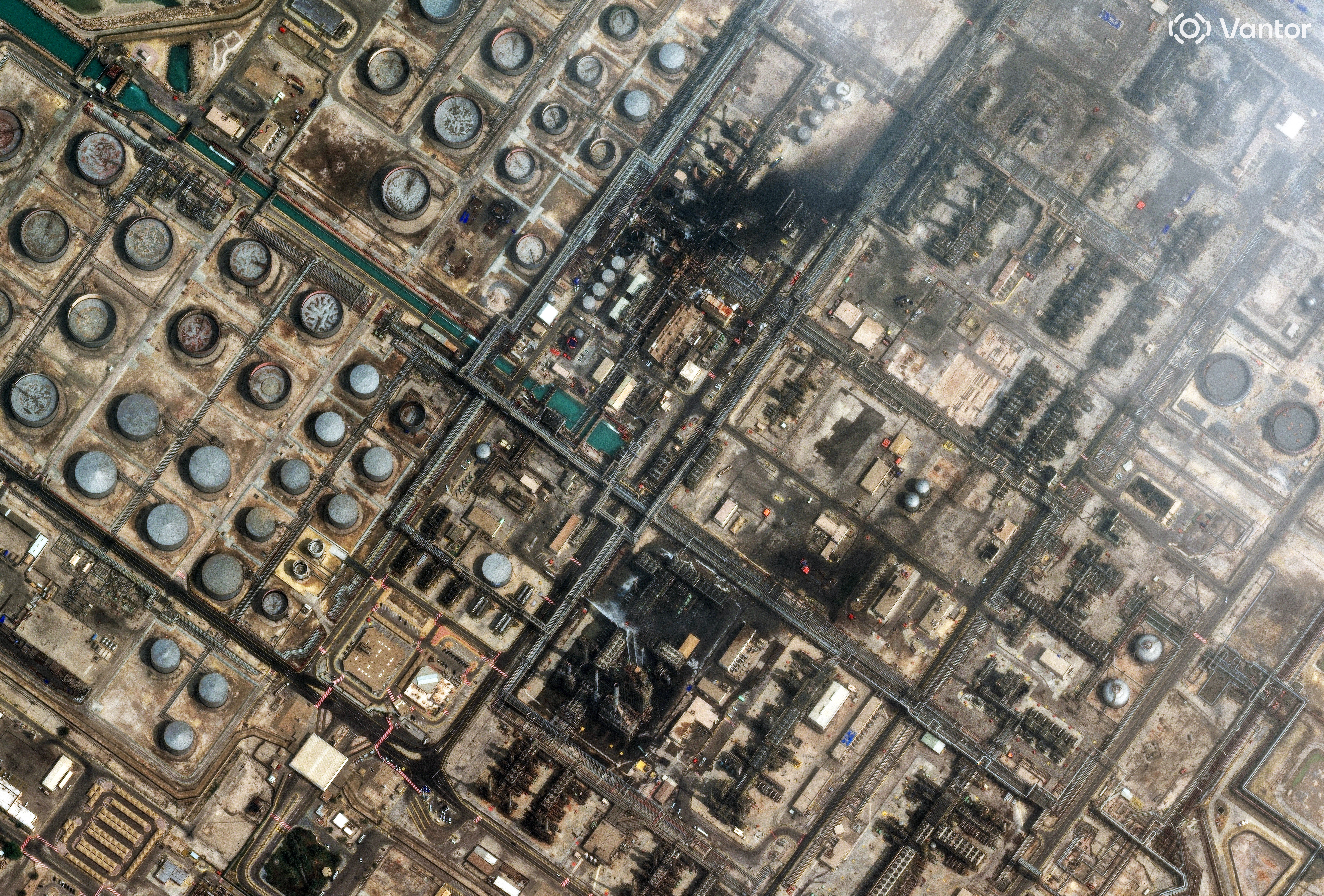
A Vantor satellite image from March 2, 2026, shows an overview of damage to facilities at Ras Tanura oil refinery in Saudi Arabia’s Eastern Province. Photo: Satellite image (c) 2026 Vantor.

Looking ahead, three factors could potentially derail Saudi ambitions:
  1. Regional Conflicts: The uninhibited expansion of regional conflicts, particularly with Iran and its proxies, could overwhelm the Saudi economy and society. An escalating war with Iran that brings large-scale destruction of strategic energy infrastructure, water desalination facilities, and civilian population centers could do generational damage to Saudi Arabia’s economy and its reputation as a safe destination for foreign investment. In addition to continued Iranian belligerence, a full-on escalation of the current conflict with the Houthis could perhaps lead to a broader regional conflagration. That could be abetted by a U.S. administration frustrated with a strategic stalemate in the Iran war, as well as reckless Israeli efforts to cement its strategic position regionally before the end of the Trump administration, after which, it may judge, its room for maneuver will be limited.
  2. Failure of Government: Second would be a failure by the Saudi leadership, government, and private sector to respond to the expectations of Saudi youth. Over 60 percent of the Saudi national population is under 35. Increasingly, Saudi Arabia will have a population for which the relative openness, diversifying economy, widening opportunities for women, and general sense of optimism among its young citizens are the norm. If the government and the private sector are unable to maintain that momentum—if jobs for Saudi citizens become scarce, the cost of living grows, and Saudi lifestyles decline—an atmosphere of national stagnation could develop in which dissent and even radicalization could take root.
  3. Dependence on Oil: The country still depends on oil to fuel its transformation. Saudi Arabia’s calculation had long been that it has time—that the global transition to renewables would take decades. Stable and relatively high oil prices were the key to leveraging that time, and so Saudi Arabia used whatever tools it had at its disposal to build markets—in Africa, for instance—and to stabilize those prices, including working with Russia in the OPEC+ construct. For a number of reasons, oil could prove increasingly unreliable going forward. This could include a sustained inability to get Saudi oil to customers due to continued restrictions on the Strait of Hormuz, escalating threats by the Houthis to shipping through the Bab al-Mandab Strait, or major damage to critical energy infrastructure. Saudi Arabia could also suffer from an accelerated global transition to renewables, possibly driven by China, which is currently Saudi Arabia’s major customer for oil exports.

Or Could the Kingdom Get its Mojo Back?

Remote Visualization

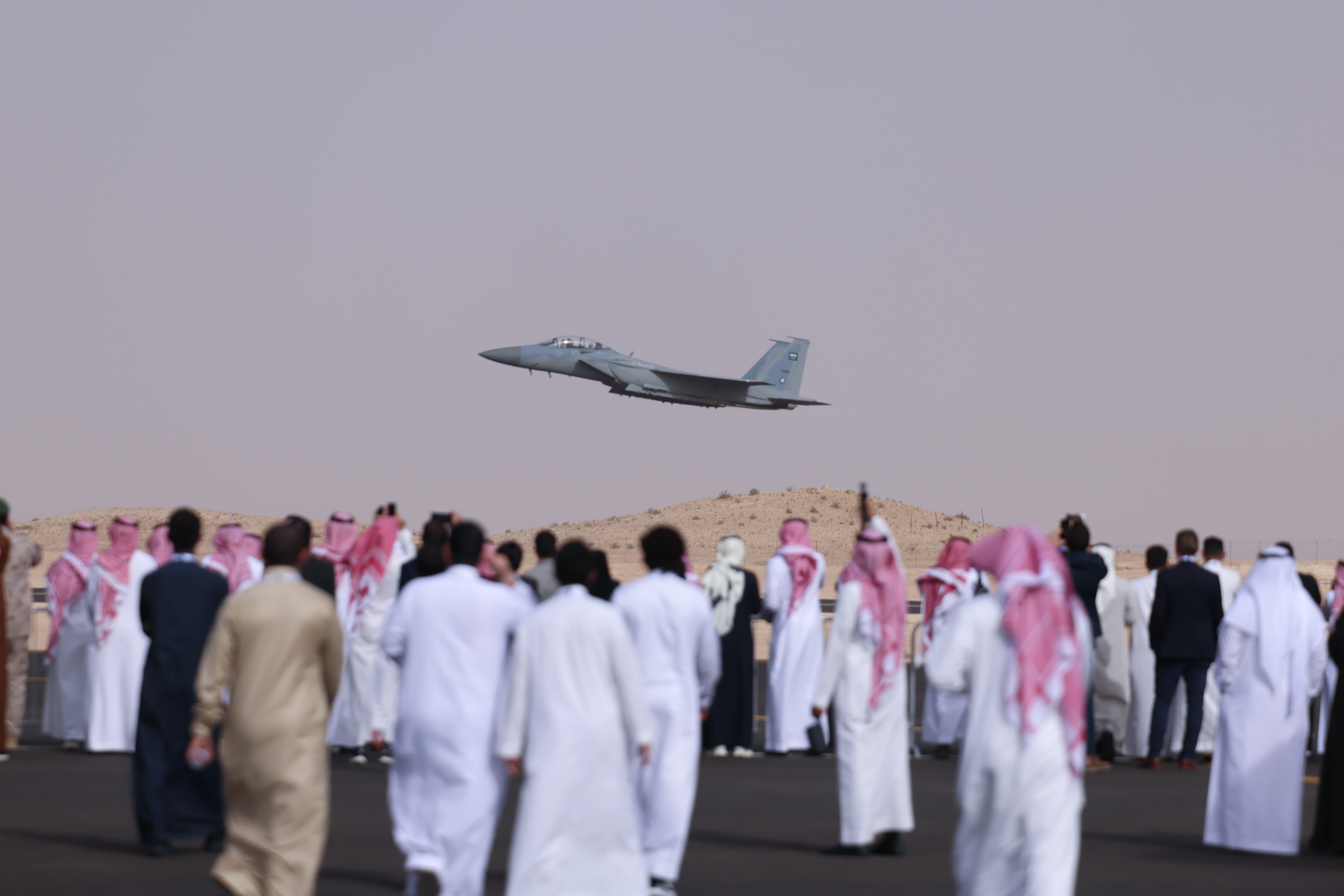
The Saudi aerobatic team performs at the World Defense Show 2026 in Riyadh, Saudi Arabia, on February 11, 2026. Photo: Wang Haizhou / Xinhua via Getty Images.

Looking ahead, the overriding Saudi priority will be to protect the country’s domestic transformation. This will likely manifest itself in four ways:

  1. First, the Saudi leadership will continue to focus on conflict de-escalation. Long before the Iran war, Saudi Arabia had come to believe that most of the region’s conflicts were not easily resolved. The best they could do would be to de-escalate the region’s conflicts, whether in Yemen, Sudan, or Syria, and defuse to the extent possible its antagonistic relationship with Iran. The goal was to keep the most destructive effects of those conflicts—radicalization, subversion, refugees, and cross-border attacks—as far from Saudi Arabia as possible.

    Saudi Arabia’s approach included mediating among warring factions in Sudan, engaging the Houthis of Yemen in a political process that implicitly legitimized their control, stabilizing post-Assad Syria, and reaching a détente with Iran that reestablished diplomatic relations seven years after they were broken.

a. Although Saudi efforts in Sudan have not borne fruit and that country remains a humanitarian nightmare for its citizens, Saudi Arabia has had little interest in actively fueling the conflict, as it believes other regional parties have done. Efforts will likely continue to isolate the Rapid Support Forces, provide humanitarian aid, and strengthen the prospects for the Sudanese Armed Forces to assert wider control in the country.

b. Saudi Arabia reached an uneasy truce with the Houthis in 2022. A UN-led “road map” in 2023, never fully implemented, then brought direct Saudi-Houthi dialogue. It was an imperfect arrangement that nonetheless bought calm—specifically, no Houthi attacks on Saudi territory. The fragility of this arrangement became clear after October 7, when the Houthis began targeting shipping in the Red Sea. The Saudi-Houthi conflict has lately escalated once again as the Houthis began targeting ships carrying Saudi oil through the Bab al-Mandab Strait as well as Saudi energy infrastructure. Riyadh has returned to military action against the Houthis, though ultimately a return to diplomacy, however imperfect, is likely.

c. Saudi Arabia’s embrace of de-escalation meant it was able to pivot easily from reengagement with the Assad regime to embracing his successor, Ahmed al-Sharaa. The two Syrian leaders may be poles apart ideologically, but for Saudi Arabia, dealing with either meant playing the cards it was dealt and embracing a measure of stability rather than quixotically trying to remake the region. Al-Sharaa fortunately gives Saudi Arabia greater latitude to help Syria recover from the war and develop its economy, as the country is no longer under U.S. sanctions nor an effective tool of Iran.

d. Reestablishment of Saudi-Iranian ties in 2023 had little effect once the U.S. and Israeli bombs started dropping on Iran. And yet, while Saudi Arabia is no friend of the Iranian regime, Saudi leadership is unlikely to advocate for an escalation of the military conflict with Iran because it knows that Saudi Arabia and its Gulf neighbors will bear the brunt of Iranian reprisals. More likely is a resumption of uneasy diplomacy, perhaps jointly with other Gulf Cooperation Council states, aimed at reestablishing freedom of navigation and blunting the belligerence of Iran’s proxies.

  1. Second, expect Saudi Arabia to accelerate development of alternative oil export routes and investment in renewable energy, both for domestic use and eventual export. The Iran war has demonstrated the vulnerability of Saudi Arabia’s energy infrastructure: Much of it is clustered on the shores of the kingdom’s Eastern Province, within striking distance of even rudimentary Iranian drones. Sophisticated air defense systems such as Patriot are effective, but also quite expensive, and thus an inefficient defense against cheap Iranian drones and missiles. Additional air defenses are one obvious course of action, but inadequate given their cost and scarcity. Besides pursuing more cost-effective solutions to the drone threat, a more durable approach will be for the kingdom to accelerate construction of alternative pipelines that reduce its dependency on both the Strait of Hormuz and the Bab al-Mandab Strait. Pipelines are not invulnerable—consider the attack on Saudi Arabia’s East-West Pipeline—and so developing innovative solutions to secure this infrastructure will also be critical.

    In the meantime, 35–40 percent of Saudi oil production is consumed domestically for electricity generation, water desalination, and gasoline for vehicles. Saudi Arabia had already embarked on several projects designed to wean its own economy off of oil dependency—the logic was that it is better to export that oil for cash before global demand tapers off. This includes projects for wind, solar, and—with the recent signing of the U.S.-Saudi agreement on civilian nuclear energy—nuclear power. Saudi Arabia hopes one day to not only transition its own economy to renewables, including to power AI data centers there, but to become a net exporter of renewable energy.
  2. Third, Saudi Arabia will diversify its strategic partnerships and place greater focus on developing and professionalizing its indigenous defense capabilities. Saudi Arabia learned a hard lesson in 2019 when Iran or its proxies struck critical energy infrastructure in the Eastern Province. For Saudi Arabia, the whole point of a military partnership with the United States was to have a partner prepared to respond—kinetically, if necessary—in the event of such an act of aggression. But in 2019, the United States effectively did nothing. It got much worse in 2026, when the United States and Israel launched a full-scale military assault on Iran with no clarity on U.S. willingness to protect the Gulf from Iran’s inevitable reprisal. Worse still were the recent Houthi attacks when, once again, the United States reportedly declined to get directly involved.

    The whole experience, from 2019 to the Iran war and the recent escalation with the Houthis, has likely had a strong impact on Saudi Arabia’s conception of regional security. In the years before the Iran war, the kingdom embarked on negotiations with the United States that would have yielded a mutual defense treaty. The guiding logic was that a closer relationship with the United States would mitigate conflict risk, particularly with respect to Iran, and a relationship with Israel—the price of the U.S. treaty—was manageable from the perspective of public opinion and might even bring practical benefits. The Iran war, however, exposed the limitations of Saudi Arabia’s security partnership with the United States, at least under President Trump. What was once thought of as an arrangement that mitigated risk and created predictability in a volatile region has shown itself to also be a major source of risk and unpredictability.

    Ultimately, Saudi Arabia is unlikely to abandon its partnership with the United States given the countries’ longstanding defense ties, including training, exercises, arms sales, and intelligence sharing. But it will likely continue to diversify its strategic partnerships, as it did with the Mecca Joint Defense Agreement. Modeled after NATO’s Article 5, the agreement brought Saudi Arabia together with Pakistan and Turkey in what is ostensibly a mutual defense pact. It may be hard to imagine that Pakistan, Turkey, or any other combination of defense partners would engage in kinetic strikes on Iran (or the Houthis, for that matter) in defense of Saudi Arabia—a basic expectation of a mutual defense treaty. But the Mecca Agreement nonetheless sends a message to the region and to Washington that the kingdom will pursue whatever arrangements it deems necessary to protect itself and its national investment in a transformed future.

    At the same time, the kingdom had already been working to develop a more sophisticated indigenous defense industry as part of its economic transformation under Vision 2030. The goal was to wean itself off dependence on foreign suppliers, including the United States, and to drive development of a domestic manufacturing base, particularly in technologically advanced industries. This effort has proved challenging—as armaments have become more technologically sophisticated, it has become harder for U.S. companies to export their development and production. But Saudi Arabia will continue to pursue this effort, with a particular focus on cost-effective air defenses. This could make the country both more self-sufficient in national defense and catalyze a broader goal of developing a twenty-first-century manufacturing sector as part of its economic transformation away from oil.
  3. Fourth, Saudi Arabia has already begun refocusing its domestic investments. The country is prioritizing “must-do” projects, particularly those with a clear business case and a clear contribution to national economic development goals. Saudi Arabia began its “era of ambition,” as embodied in Vision 2030, with more ambition than focus. The last few years, even before the Iran war, forced a reprioritization away from some of the grandest projects. Some of the major projects will go ahead, including Expo 2030, and the FIFA World Cup a few years later. Others have already been shelved, including the 100-mile-long glass city in the desert called The Line, and the winter sports resort of Trojena. Both were to be in NEOM, which was conceived as a futuristic state-within-a-state in Saudi Arabia’s northwest, a massive project that itself may be sharply curtailed. Many of the individual projects within NEOM lacked a strong business case or were simply too expensive to realize, even if oil prices were sustainably higher.

    Although foreign observers tend to use Saudi Arabia’s so-called giga-projects as a metric for Vision 2030’s success, the most consequential transformations in the country have been its social changes, which in financial terms cost very little: the effective emancipation of women, loosening of oppressive societal restrictions, and changes to the Saudi educational system. These need not be affected by a refocusing of the country’s national economic ambitions. At some point, the Iran war will be over, and while the resolution may be politically unsatisfying, it should mean the full resumption of oil exports that fuel the Saudi economy to a global market that still thirsts for energy. The Iran war and other perturbations in the region may well have slowed the momentum of Saudi ambitions, but they are unlikely to thwart them.

Michael Ratney is a senior adviser (non-resident) in the Middle East Program at the Center for Strategic and International Studies in Washington, D.C.